The short answer: when someone asks ChatGPT for the best real estate agent in their city, it looks things up and names the agents that the pages it reads describe clearly and often. Those pages are mostly Google Business Profiles (the listing that shows up on Google Maps), big directories like Zillow, and agents’ own websites. In one study of 37,500 AI searches, only about one in five top-selling agents with a website was cited at all, so a strong sales record on its own doesn’t get you named. A page has to say it.
What happened when we asked about one city?
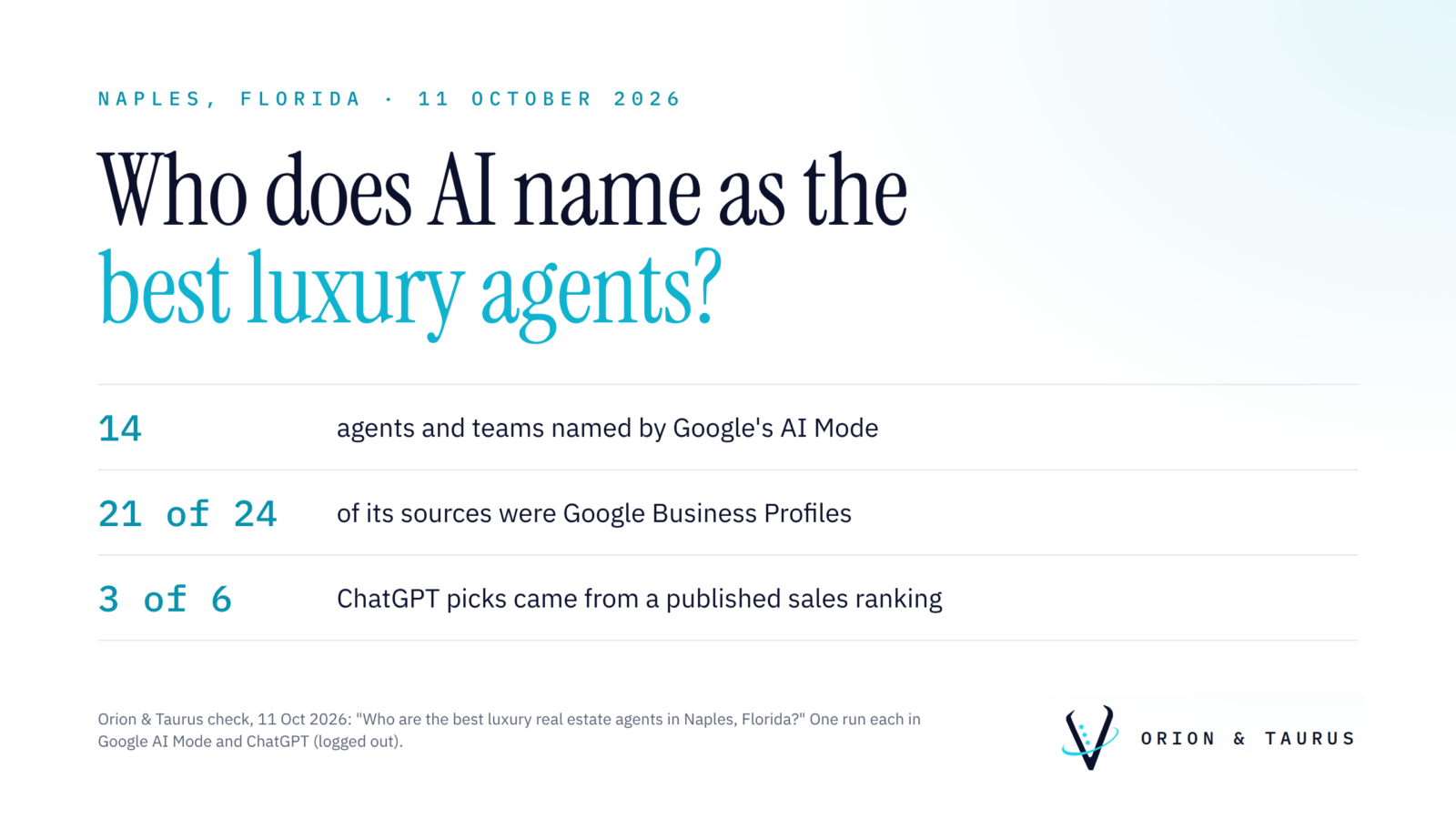
On 11 October 2026 we asked Google’s AI Mode and ChatGPT, logged out, the same question: “Who are the best luxury real estate agents in Naples, Florida?”
Google’s AI Mode named 14 agents and teams and listed 24 sources. 21 of the 24 were Google Business Profiles. The other three were RealTrends’ 2026 ranking of Naples agents by sales, a U.S. News list of top local agents, and one agent’s own website, which puts his sales ranking in its page title.
ChatGPT named six. It took three straight from that RealTrends ranking, cited Google Business Profiles for two more, both rated 5.0, and described the last from his own published profile.
Every agent either assistant named had a place on a published sales ranking, a Google profile rated 4.8 stars or higher, or both. The top sellers did get named, but only because RealTrends had published their numbers where an assistant could read them.
It’s one question on one day, and the answers shift from run to run, but it’s the same pattern the larger studies found.
Is that just one city?
No. Two larger studies, both from companies that sell AI visibility tools or services, looked at this at scale. Both found the assistants draw on a narrow set of sources, and one found that, asked a different way, most top-selling agents weren’t named at all.
Local Falcon ran 37,500 searches in August 2026 across the 100 largest US cities, asking ChatGPT, Gemini, Grok and Google’s AI answers for the “best realtor near me” and similar. In its Realtor AI Visibility Index:
- 91.5% of the agents and teams on RealTrends’ 2026 production rankings who publish a website were never cited.
- Only 21.2% of the 10 highest-selling individual agents in each city who have a website were cited at all.
- Google Business Profiles were the biggest single source, at 36.6% of citations, almost all of them in Google’s AI Mode. Zillow came next at 15.9%, and was ChatGPT’s top source. Agents’ own websites made up about one citation in nine.
- 18 of the 25 most-cited agent websites carry a “best real estate agents in [city]” page, and Local Falcon says the agent who publishes the page is almost always the one named best on it.
Omni Eclipse looked at 334 ChatGPT answers about the “best real estate agents” and “best luxury real estate agents” in 197 markets across the US, UK and UAE, between April and May 2026 (2026 Real Estate AI Search Report). ChatGPT named a median of six businesses per answer. 57.6% of the sources it cited were Google Business Profiles or Maps listings, and 40.5% were the named businesses’ own websites (agents, teams and brokerages). The reason it gave most often for recommending someone was their number of reviews, in 52.7% of answers.
The two studies disagree on where ChatGPT gets its answers. Local Falcon found ChatGPT’s top sources were Zillow (39.8%) and Realtor.com (18%), while Omni Eclipse found ChatGPT cited Zillow no times at all and leaned on Google profiles and the businesses’ own sites. They asked different questions (“near me” against “in [city]”), months apart, and counted citations differently, which may explain some of it. It’s a good reason to check more than one way of asking.
Does this matter if most of my business comes from referrals?
Referrals aren’t going anywhere. In the National Association of Realtors’ 2025 Profile of Home Buyers and Sellers, 37% of sellers found their agent through a friend, neighbor or relative, 29% used an agent they’d worked with before, and 80% contacted only one agent.
We haven’t found a study that measures how many referred clients look an agent up in an AI assistant before they call, so we won’t claim they do. What has been measured is how many people already use AI for homebuying. Bank of America’s 2026 Homebuyer Insights Report found one in five prospective buyers and homeowners used AI tools for homebuying research in the past year, including 28% of Millennials and 32% of Gen Z. And about a third of sellers in NAR’s survey didn’t find their agent through a referral or a past agent, so they had to find one some other way.
How do I get ChatGPT to recommend me?
We work through the same five steps with every client, in this order, because each one depends on the one before it.
- Reachable. AI companies send programs called crawlers to read websites, and they have to be able to get into yours. Agent websites are usually built by a vendor, so ask yours whether anything blocks them.
- Resolvable. The assistant has to work out who you are. Your name, brokerage, office address and phone should match wherever you control them. Agents who’ve changed brokerages can still have the old one showing on some of their profiles.
- Corroborated. Other sites need to agree about you: your Google Business Profile, Zillow, Realtor.com, your brokerage’s page and your reviews.
- Cited. You need pages that answer what buyers actually ask, such as the homes you’ve sold and the neighborhoods you know. Describe the homes, streets and amenities rather than who lives there, which also keeps you clear of fair housing problems.
- Referred. The assistant sends someone your way: they read the answer, click through and get in touch.
You can’t skip a step. A beautiful website does little if the assistant can’t tell it’s yours, and a perfect profile does little if nothing else backs it up.
How can you check this yourself in ten minutes?
- Open ChatGPT in a private browser window, logged out, so it can’t draw on your chat history, and ask “Who are the best luxury real estate agents in [your city]?”
- On your phone, near your office, open Google’s AI Mode and ask “Who’s the best realtor near me?”
- Note who’s named, then click the sources under each answer. Those are the pages doing the talking.
- Search your own name on Google and look at your Business Profile. Check that your name, brokerage, office address and phone match your website. If you don’t have one, ask your broker about setting one up. It’s usually the first fix.
Where do we come in?
Orion & Taurus is our AI visibility practice. We’re Alex and Jenn Hays, and this is the work we sell. We work alongside the company that built your website: they keep looking after the site, and we work on what AI assistants can find and read about you, then hand your web team an exact list of fixes.
If you have your own website and you’d like to start with what the assistants say about you now, our free AI Answer Snapshot asks ChatGPT and Claude about you, and a few questions your buyers might ask, then emails you a short report: what they say about you, who they name instead, whether AI crawlers can reach your site, and three fixes to start with. No call needed. If you don’t have your own website yet, we build those too, set up to follow your brokerage’s advertising rules.
Get your free AI Answer Snapshot
Related reading: AI visibility vs. SEO: what changes? and Why doesn’t ChatGPT know my company?