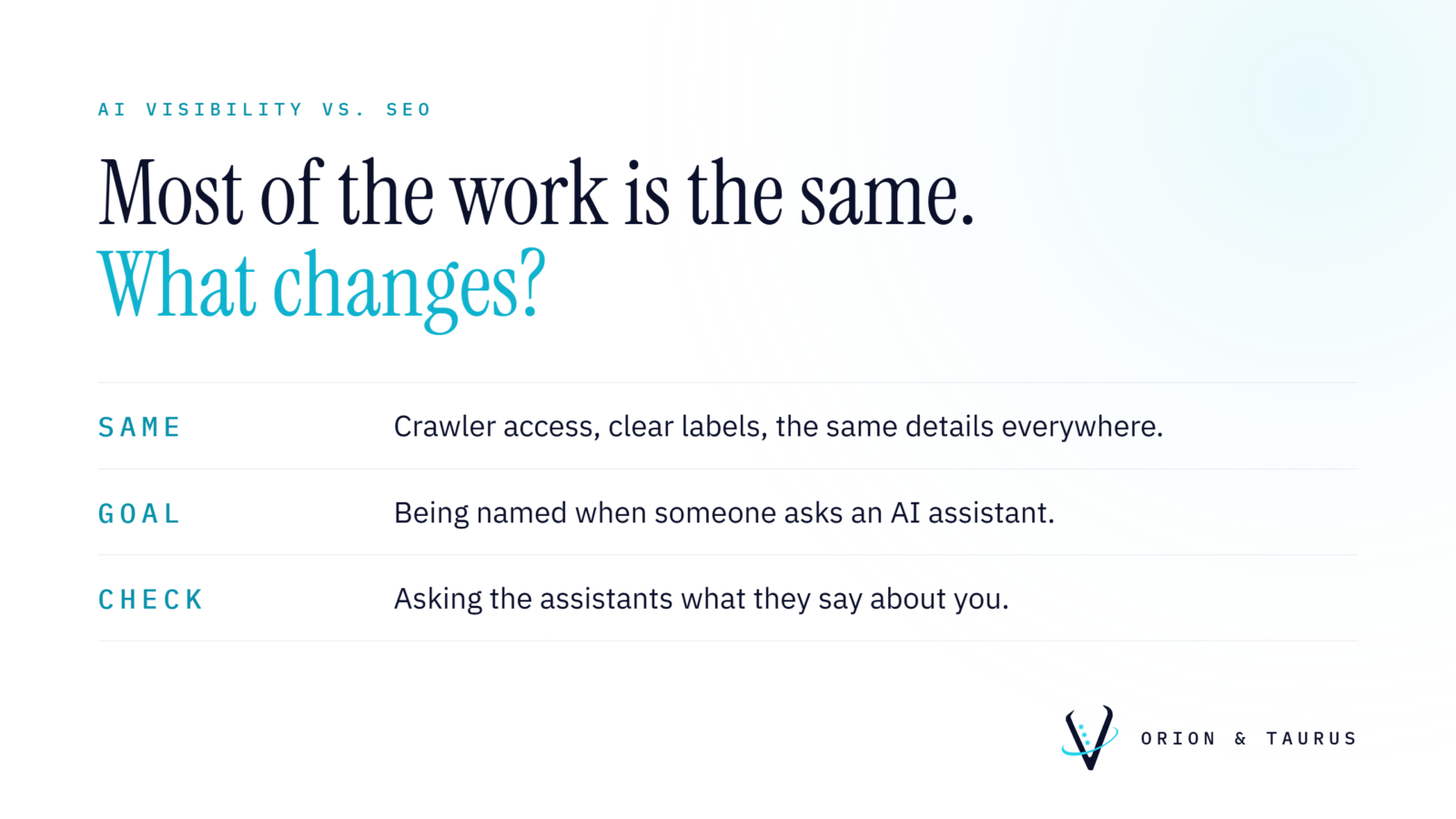
The short answer: a lot of the work is the same. SEO, short for search engine optimisation, is the work of helping your website show up in search results. AI visibility is whether assistants like ChatGPT know who you are and mention you when someone asks. If someone already looks after your SEO, they’re probably doing a good share of what AI assistants need. What changes is the goal and the check. The goal moves from ranking in a list to being named in an answer, and the check moves from reading a rankings report to asking the assistants yourself and reading what they say.
What’s the same?
More than you might expect, and it’s worth knowing which parts you’re already paying for.
Letting the right programs in. AI companies send automated programs, called crawlers, to read websites. Making sure they can reach your pages is the same kind of technical work SEO has always done for search engines. We’ve written about checking this yourself in Which AI crawlers are hitting your site?
Labelling your pages clearly. Structured data is a small block of code that tells a machine “this is a business, and here’s its name, address and phone number.” SEO has used it for years. Microsoft says it helps AI systems understand your pages too, and Google says the main thing is that it matches what’s on the page.
Saying the same thing everywhere. Your business name, address, phone number and a one-line description of what you do should match on your website, your LinkedIn page, your map listings and directories like Yelp or your chamber of commerce. SEO people call this consistency, and it matters just as much when an assistant is trying to work out who you are.
Being mentioned by sites people trust. When respected websites, such as your trade association, your local paper or a well-known directory, mention you, search engines take you more seriously. AI assistants work the same way in one respect: their answers draw on what other websites say, not just yours, so when respected sites mention you, there’s more for them to go on.
If your SEO person does all four, a lot of the groundwork is already covered.
What’s different?
An assistant names a few businesses, and there’s rarely a page two
A page of search results is a list, so ranking seventh still gets you seen. Ask an AI assistant the same question and you’ll usually get a short written answer that names a handful of businesses, sometimes only one. Some show a map or a list of sources too, but there’s rarely a page two to scroll. You’re either in the answer or you’re not.
People click less when there’s an answer on the screen
Pew Research Center studied the real browsing of 900 US adults, with their permission, in March 2025. On Google searches that showed an AI summary at the top, people clicked a regular result in 8% of visits. On searches without one, it was 15%. A link inside the summary itself was clicked in just 1% of visits. That study only covered Google’s AI summaries, not ChatGPT, but it shows the direction: when an answer is on the screen, fewer people click past it, so what the answer says about you matters more than it used to.
Can a live website still get missed or misdescribed?
It can, and it happened to us. In late August our website was live and the AI crawlers could reach it. When we asked ChatGPT who Orion & Taurus is, it told us about the constellations: Orion the Hunter and Taurus the Bull. When we asked Google’s AI Mode, and named what we do in the question, it found us but described us the way an old website of ours still did, rather than the way we describe ourselves now. The source it cited was that old site. We hadn’t caught it, which is the “saying the same thing everywhere” problem above. We wrote up the full test in Why doesn’t ChatGPT know my company?
A rankings report wouldn’t have caught either answer, because both were about what the assistant thought we were, and the only way to see that is to ask it.
Your usual reports mostly won’t show it
Rankings reports, website analytics and search dashboards were built to measure clicks and positions. A few now count how often an assistant cites your pages, but most don’t show you what ChatGPT, Claude, Perplexity or Microsoft’s Copilot actually said about you this morning, who they named instead, or which websites they leaned on. The answers change, too, so it’s worth asking again each month.
So do you need both?
If you already have an SEO person, keep them, and make sure someone’s also checking what the assistants say when your buyers ask, because that’s the part their reports may not show.
That’s where we start. We ask the assistants, work out why they say what they say, and fix what’s ours to fix, working alongside whoever handles your SEO. We’ll tell you which findings are really their job, so nothing gets paid for twice.
One question to ask your SEO person
Have you asked ChatGPT or Copilot what they say about us, and what did they say? If the answer’s no, you’ve found the gap.
Want to see what the assistants say about you?
We’re Orion & Taurus, Alex and Jenn Hays. Send us your website and one question a buyer might ask about what you do. We’ll ask ChatGPT, Claude, Perplexity and Microsoft’s Copilot that question and send you their answers word for word within two business days, at no charge. Answers can change from day to day, so treat it as a picture of that day. If there’s a simple fix, we’ll tell you how to make it yourself. If it’s bigger, we’d like the work, and we’ll say so.